Automated storage systems can increase storage capacity in breweries from one to up to five pallets per square metre. System Logistics designs and implements such facilities for breweries and beverage manufacturers across German-speaking countries as well as Central and Eastern Europe.
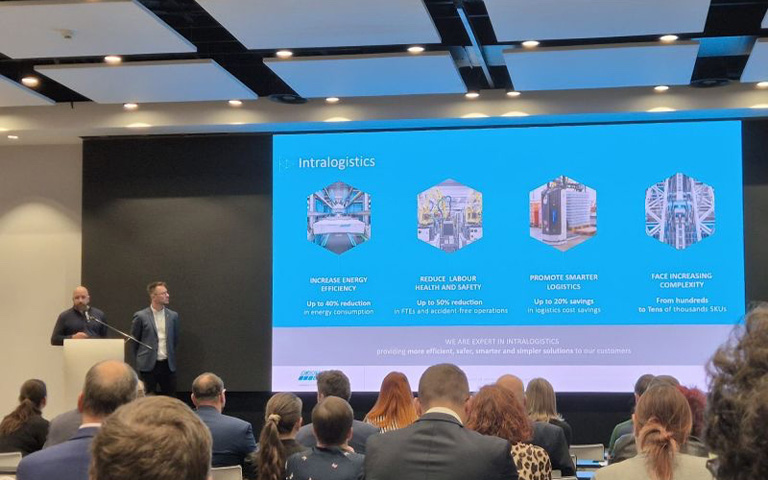
The challenges involved and the potential benefits were the focus of a joint presentation with Pilsner Urquell at Brewery Days 2026.
The Current Situation in the Brewing Industry
Breweries are facing several challenges simultaneously. Energy and material costs have risen and remain volatile. Recruiting and retaining staff for shift work and warehouse operations is becoming increasingly difficult. Retailers and end customers expect shorter delivery times while maintaining consistent product availability.
Sustainability requirements now extend beyond production to include space utilisation and energy consumption in logistics. Seasonality adds another challenge. Breweries produce continuously, while demand fluctuates considerably. Storage capacity is therefore not a secondary concern – it determines how effectively a business can handle peak demand.
Five Pallets Instead of One: Making Better Use of Available Space
The greatest potential lies in optimising space utilisation. With conventional storage, a warehouse typically accommodates around one pallet per square metre of floor space. An automated system can achieve up to five pallets within the same area.
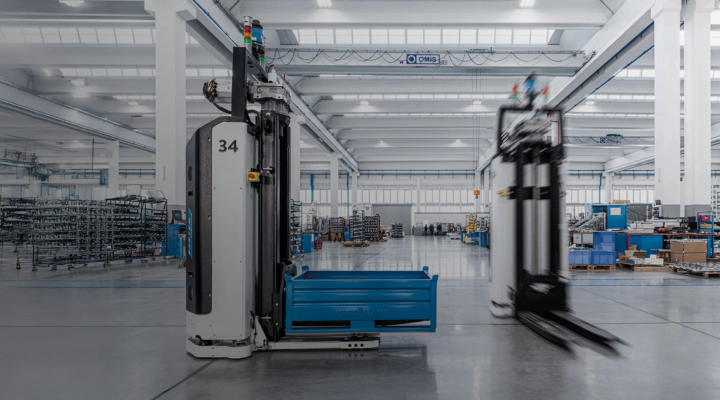
This is made possible by combining greater warehouse heights with narrow aisles and multiple-deep storage. Stacker cranes can access storage locations that would no longer be reachable by a human-operated forklift truck.
For a business, this offers two key advantages. Existing floor space can be used more efficiently for longer, and production can be expanded without requiring additional space for logistics. Where site availability or building approval is limited, this can often be the deciding factor.
What Else Automation Changes
Manual operations:
Storage and retrieval processes take place without forklift truck traffic. This reduces staffing requirements and minimises damage to goods and racking.
Operating costs:
Fewer industrial trucks, reduced staffing requirements for warehouse operations and lower energy consumption per stored pallet.
Inventory management:
Every pallet is tracked within the system. Inventory discrepancies and time spent searching for goods are largely eliminated.
Supply chain transparency:
Inventory levels, batches and best-before dates can be accessed at any time, including by upstream and downstream systems.
Control:
Material flow control prioritises orders and synchronises production and dispatch cycles, ensuring that both processes work together efficiently.
Building the Foundation for AI Today
Artificial intelligence in logistics is currently a widely discussed topic, but its practical implementation remains limited. The reason is rarely the technology itself, but rather the availability of data. A manually operated warehouse does not generate usable data on movements, utilisation and bottlenecks.
An automated system generates this data continuously during operation, in a complete and structured format. By investing in automation today, companies lay the groundwork for integrating AI applications into existing processes at a later stage without having to modify the system itself. The key is to ensure that open interfaces are incorporated from the outset.
Presented in Collaboration with Pilsner Urquell
These topics were addressed in the presentation “Challenges in the Beer Industry and How Logistics Automation Can Improve Competitiveness” at Brewery Days 2026 in the Czech Republic. The presentation was delivered by David Tena, Head of Market Operations at System Logistics, and Tomás Sedláçek, Warehousing Manager from Pilsner Urquell.
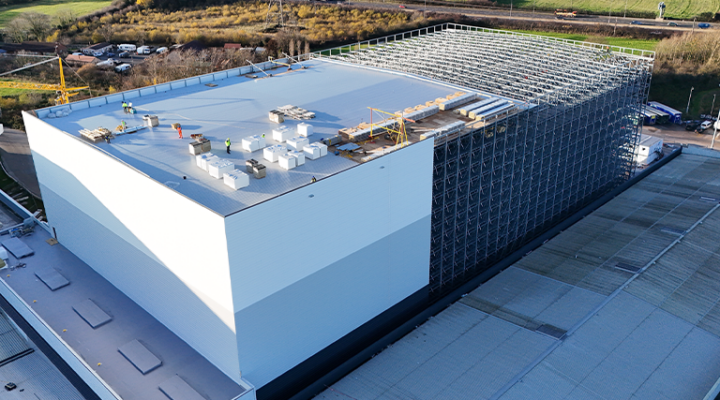
For Pilsner Urquell, System Logistics implemented a rack-supported high-bay warehouse with 41,500 pallet storage locations and a system throughput of 390 pallets per hour, delivered in two implementation phases.
We would like to thank all participants for the engaging discussions on site.

REQUEST AN ANALYSIS
WEITERE INFORMATIONEN