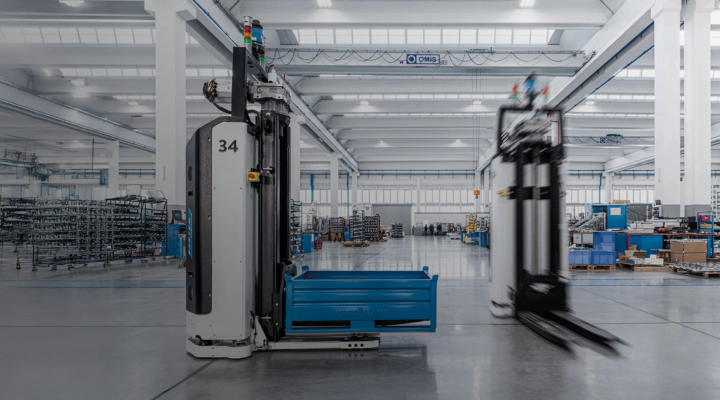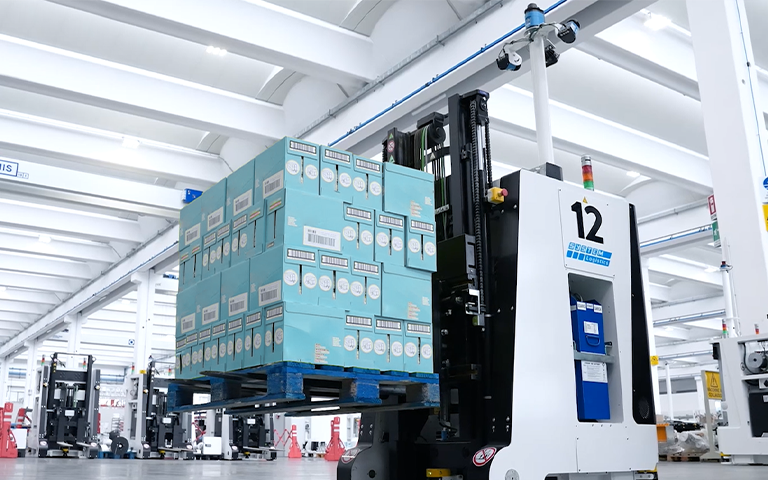
An Automated Guided Vehicle (AGV) system handles in-house transport without a driver – around the clock, safely and reliably. It supplies production lines, serves warehouses and connects areas that would otherwise require forklifts and personnel. We explain how an AGV system works, where it is used and when it makes economic sense.
Key figures:
How an AGV system works
An Automated Guided Vehicle (AGV) system consists of one or more autonomous vehicles, a fleet management system and a navigation system. The vehicles move independently along predefined routes and automatically carry out transport tasks. The fleet management system allocates transport orders, optimises routes and connects the system to warehouse operations and IT systems.
Where AGV systems are used
- Production supply and removal: Supply and removal of materials at production lines; transport of raw materials, auxiliary materials and operating supplies.
- Block storage: Storage and retrieval; preparation for dispatch.
- Order picking: Delivery and removal at transfer stations.
- Connecting different areas: Linking warehouses, production and dispatch without the need for forklifts.
Navigation methods
- Laser navigation: Reflectors serve as reference points, providing a high degree of accuracy.
- QR code or line-guided navigation: Markers on the floor provide robust and straightforward guidance.
- Hybrid navigation: Combines different navigation methods to ensure accuracy and reliability under changing conditions.
When to consider an AGV system
An AGV system becomes a worthwhile investment when recurring transport tasks tie up personnel – such as production line supply, replenishment and the transport of empty containers. Its benefits are particularly evident in multi-shift and 24/7 operations, where it relieves employees of repetitive transport tasks and makes material flows more predictable. For technical details on vehicle types, energy supply and safety, visit our AGV solutions page.
Our approach
We design vehicle types, routes, stations and supporting IT applications to suit your processes, operating environment and performance requirements. Every project begins with an analysis of your transport operations and routes – independently of any manufacturer and with an honest assessment of the return on investment (ROI).
Frequently asked questions (FAQ)
AGV stands for Automated Guided Vehicle. The term refers to driverless vehicles used for in-house transport.
Safety is ensured through safety zones, sensors, visual and audible warning signals, and clearly defined traffic rules. Transfer points are designed to minimise potential hazards.
Level floors with sufficient load-bearing capacity are essential. We assess floor conditions as part of a feasibility study and plan any necessary modifications.
Next steps
Review your route plan or book an initial consultation
Further information